How to Use Loctite® 406 — The Tiny Tube That Fixes Big Problems
Let’s be honest:
we’ve all been there — that frustrating moment when a small but crucial piece breaks. A plastic handle snaps, a rubber seal tears, a clip disappears into the void. You sigh, because you know super glue usually doesn’t stick to rubber or plastics properly.
And then, someone whispers two magical words: Loctite 406.
Now, this isn’t just another “instant glue.” Loctite 406 is like the ninja of adhesives — quiet, precise, lightning-fast, and weirdly satisfying to use. If regular glue is the duct tape of the world, Loctite 406 is the surgical tool.
So let’s dive in, friend to friend, and talk about how to actually use this little legend like a pro.
Meet Loctite 406: The Speed Demon of Glues
First things first — what is this stuff?
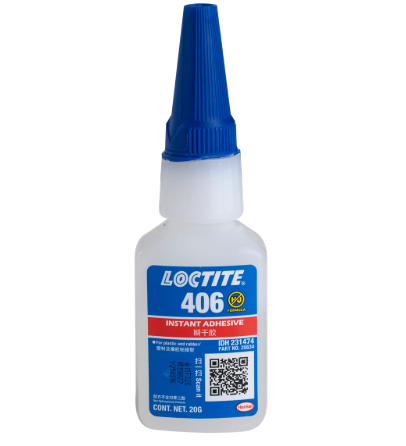
Loctite 406 is a low-viscosity cyanoacrylate adhesive, designed specifically for bonding plastics and elastomeric materials (that’s fancy talk for rubbery things).
If regular super glue is a jack-of-all-trades, Loctite 406 is a specialist — the kind that works quietly in the corner and makes everyone else look bad.
It’s perfect when:
- You’re working with plastic parts (like ABS, PVC, polycarbonate, or acrylic).
- You need to bond rubbers — nitrile, neoprene, silicone (with a primer).
- You want speed. Like “I’m-late-for-work-and-need-this-fixed-now” speed.
The best part? It’s one-part — no mixing, no measuring, no “Part A and Part B” chemistry lesson.
You open the cap, apply a drop, and it’s already doing its thing.
So, How Long Does Loctite 406 Take to Dry?
Here’s where it gets fun.
While most glues make you wait around like you’re watching paint dry, Loctite 406 bonds in seconds.
Literally.
Depending on the material, you’ll get initial “fixture time” (that’s the moment it holds firm) in about 5–30 seconds. That means before your brain can even form the sentence “I hope this works,” it probably already has.
But — and this is important — fast doesn’t mean instant. Loctite 406 continues curing for several hours. To hit its maximum strength, give it around 24 hours.
So yes, it’ll hold fast in seconds, but full power takes patience (like coffee brewing — you can sip early, but it’s better later).
Why It Works So Well (and Why Others Don’t)
Here’s the science made simple:
Loctite 406 cures when it meets moisture — even the tiny traces in the air or on your material’s surface. That’s why it’s sometimes called a “moisture-activated” adhesive.
When it hits that micro-thin water film, it polymerizes (meaning molecules form long chains that solidify the bond). The result is a strong, tight, clean joint that feels like the material was never broken.
Most generic glues can’t do this with plastics or rubber because those surfaces are non-porous and chemically resistant.
Loctite 406, however, was formulated precisely for them. It’s like the secret handshake between plastic and glue.
How to Apply Loctite 406 Correctly (Don’t Skip This)
Let’s walk through it like we’re standing in your workshop right now.
1. Clean the surfaces.
Don’t skip this.
Even if it looks clean, oils from your hands, dust, or mold release agents can mess up the bond.
Wipe both surfaces with a clean cloth and a bit of isopropyl alcohol. Let them dry.
2. Do a quick test fit.
Line the parts up before you touch the glue. Loctite 406 doesn’t give second chances — once it bites, it bites.
3. Apply a small amount.
This glue is runny — almost water-like.
A tiny drop goes a long way. In fact, too much glue actually weakens the bond because the middle can’t cure properly. Thin is strong. Think “less paint, better finish.”
4. Press the parts together.
Once you’ve applied that drop, align your parts and press them firmly.
Hold for about 10–20 seconds. You’ll feel it grab.
No clamping? No problem. But if your parts are awkward, a light clamp helps maintain alignment.
5. Let it cure fully.
Now that the part feels solid, don’t get overconfident.
Leave it alone for a day.
After 24 hours, it reaches its full, industrial-level strength.
6. Clean the tip and seal tightly.
Wipe off any residue before closing the bottle. Air exposure can thicken it over time.
Bonus tip: store it in a cool, dry place (some people even refrigerate it). It’ll last much longer.
Pro Tips for Flawless Bonds
1.Humidity matters. Loctite 406 likes a little moisture to cure — around 40–60% relative humidity is ideal. Too dry and it’ll cure slower.
2.Big gaps = bad news. This glue loves thin joints. If you’ve got a big gap, fill it first or use a thicker grade cyanoacrylate.
3.Bonding “difficult” plastics? Some plastics (like polyethylene, polypropylene, PTFE) are stubborn. Use Loctite Primer 770 first — it chemically preps the surface so the glue can stick.
4.Less is more. A tiny bead is stronger than a puddle.
5.Don’t touch the tip to the surface — that contaminates the nozzle and shortens shelf life.
What Can You Use Loctite 406 For?
Think of it as your emergency repair kit in a bottle.
Here’s where it shines:
- Plastic housings: phones, remotes, appliance covers.
- Rubber seals & O-rings: perfect for quick gasket fixes.
- Shoes or rubber soles: small tears? A drop seals them fast.
- Automotive & electronics: small clips, connectors, or insulation points.
- Hobby projects: drones, 3D prints, RC cars — anything with plastic bits.
- Industrial assembly: manufacturers use it to fix plastic and rubber components where waiting hours isn’t an option.
Basically, if it’s small, non-porous, and needs to stay stuck — 406 is the answer.
How Strong Is Loctite 406? (The Numbers Behind the Magic)
Let’s talk power.
According to testing data:
- On steel, it hits shear strengths of around 15.5 N/mm² — that’s roughly 2,200 psi.
- On ABS, PVC, polycarbonate, it lands between 8–10 N/mm².
- On rubbers, the numbers are lower (1–2 N/mm²), but still impressive for flexible materials.
Translation: for small-scale repairs, it’s easily stronger than the parts themselves. Often, the material breaks next to the joint rather than at it. That’s the adhesive equivalent of a mic drop.
When Not to Use It
Even superheroes have limits.
- It’s not ideal for large gaps — it likes thin surfaces.
- It doesn’t love porous materials (like wood or foam).
- Flexible joints may stress the bond over time.
- And while it can handle occasional heat, constant high-temperature environments aren’t its favorite playground.
If you need gap filling or flexibility, you’re better off with an epoxy or a silicone adhesive. Think of 406 as the scalpel, not the hammer.
Safety Talk (Because We’re Responsible Adults)
Yes, it bonds skin in seconds.
If you glue your fingers together — and we’ve all done it — soak them in warm, soapy water and gently peel apart. No ripping!
Avoid eyes and always work in a ventilated area. The fumes aren’t deadly, but your nose will complain.
Real Talk: Why Loctite 406 Deserves a Spot in Your Toolkit
Loctite 406 isn’t just another tube of glue — it’s the “get-out-of-trouble” button every DIYer, mechanic, or engineer should have. It’s the difference between throwing something away and fixing it in 30 seconds flat.
It’s what manufacturers use behind the scenes when they can’t afford downtime.
It’s what hobbyists use when a project part cracks at 11 PM.
And it’s what you can use right now to fix things you thought were unfixable.
The Bottom Line
Loctite 406 is a reminder that not all heroes wear capes — some come in 20-gram bottles.
Use it with care, keep your surfaces clean, go light on application, and let it cure fully. You’ll end up with joints that look seamless and hold like factory bonds.
So next time something snaps, don’t panic — smile, grab that blue-and-white bottle, and whisper to yourself:
“Let’s see you come apart now.”
Because with Loctite 406, chances are… it won’t.