Let me save you from the nightmare I just lived through.
Picture this: It’s 11 PM on a Sunday. I’m kneeling in my living room, surrounded by what can only be described as an “art supply explosion.” I’ve just spent four hours reupholstering a vintage ottoman I found on Facebook Marketplace. The fabric is perfect — this incredible mustard yellow velvet that took me three weeks to find.
I grab my spray adhesive. I spray. I press.
Ten minutes later, I peel my hand away, and the fabric comes with it.
Not just a little corner. The entire thing. Like a sad, floppy ghost wearing my dream project.
My husband walks by, sees the look on my face, and just slowly backs out of the room. Smart man.
That was my third failed attempt at bonding fabric to wood. Third! And I was ready to throw every aerosol can in my garage into the sun.
But here’s the thing I learned after testing seven different spray adhesives (and making approximately 847 mistakes along the way): You don’t have a glue problem. You have a “using the wrong adhesive for your specific project” problem.
And that’s exactly what I’m going to fix for you today.
Quick Comparison Table: Key Differences at a Glance
| Product | Best For | Tack Time | Bond Strength | VOC Level | Repositionable? | Price Point |
|---|---|---|---|---|---|---|
| 3M Super 77 (24 oz) | General purpose, versatile projects | 15-30 seconds | Strong | Standard | Yes (brief window) | $$ |
| Gorilla Contact Adhesive | Heavy-duty, outdoor, car headliners | ~1 minute | Extreme | Standard | No | $$ |
| Loctite Professional 300 | Marine, high-heat, demanding projects | ~10 min set | High | CARB Compliant | No | $$$ |
| 3M Hi-Strength 90 | Large surfaces, industrial strength | Fast | Maximum | Low VOC | No | $$$ |
| Polymat 777 | Upholstery, speaker boxes, foam | Fast tack | Foam-tearing | CFC-free | No | $ |
| 3M Foam Fast 74 | Foam + fabric lamination | Fast | Foam-tearing | Low (<25%) | Yes | $$ |
| 3M Super 77 (13.5 oz Low VOC) | Indoor crafts, school projects | Fast | Moderate | Low | Yes | $ |
Spoiler alert: There’s no single “best” adhesive. But there IS a best adhesive for YOUR specific project. Keep reading, and I’ll tell you exactly which one to buy.
Individual Product Reviews (The Real Talk Edition)
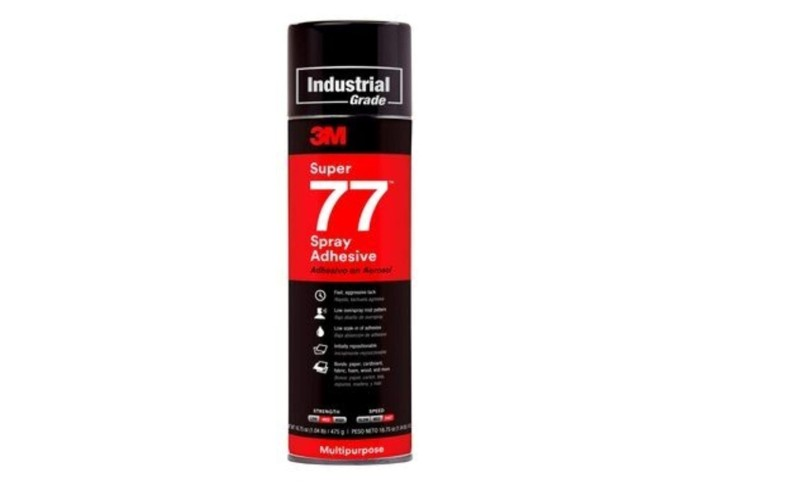
3M Super 77 021200-96315 Classic — The Old Reliable
The one your grandpa used. And for good reason.
Look, I know “classic” sometimes means “outdated,” but hear me on this. The 3M Super 77 is like the Toyota Camry of spray adhesives. It’s not flashy. It won’t win any drag races. But damn, it just works.
I used this on a fabric-to-wood headboard project last year. We’re talking 4 feet by 5 feet of linen blend onto pine. I sprayed, waited about 20 seconds (the 15-second application time is no joke — this stuff sets up FAST), and pressed.
That fabric hasn’t budged. Not through two moves, a toddler who likes to bounce on the bed, and my dog using it as a back scratcher.
The good: Super versatile. Works on fabric, wood, cardboard, plastic, metal — honestly, I think it would bond a broken heart if you sprayed it right. The aggressive tack means you get good initial grab, but you still have juuuust enough time to reposition if you mess up.
The bad: The 24 oz can is BEEFY. Like, “my wife asked if I was starting a fire with that thing” beefy. Also, the overspray is real. Protect your work surface unless you want glue glitter forever.
Best use case: General upholstery, crafting, mounting fabric panels to wood frames, and basically any project where you need a strong, permanent bond without getting too specialized.
Pro tip from someone who learned the hard way: This stuff works vertically without dripping. I used it to attach fabric to the inside of a bookshelf back panel, and it stayed put. No drips down my freshly painted white shelves. Thank you, 3M.
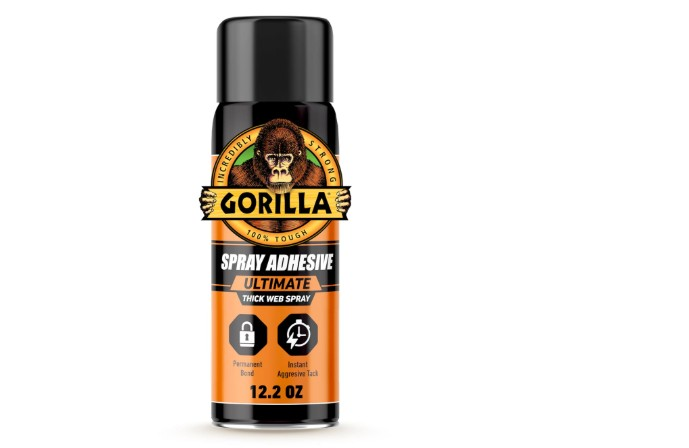
Gorilla Contact Adhesive Ultimate — The Heavy Hitter
When you need a bond that could survive a hurricane
Okay, story time. My buddy builds custom speaker boxes for car audio competitions. These things get THRASHED — heat, humidity, vibration, you name it. He swears by Gorilla’s contact adhesive.
I borrowed some for a project attaching marine-grade vinyl to plywood for a boat storage compartment. Y’all. This stuff is aggressive.
The adjustable anti-clog nozzle is genuinely useful, not just marketing fluff. You can twist it to get three different spray patterns, which matters more than you’d think when you’re trying to cover a large surface evenly.
The good: This thing resists heat and moisture like a champ. The bond is permanent — like “you’ll destroy the wood before you separate the fabric” permanent. Works on a crazy range of materials: heavy-duty fabric, car headliners, foam, rubber, felt, cork, ceramics, laminate, leather, metal, plastics, wood, canvas. It’s basically the Chuck Norris of adhesives.
The bad: You get ONE chance. This is NOT repositionable. Once those two surfaces touch, they’re married for life. No take-backs. No divorces. Also, the dry-to-tack time is about a minute, so you need to work deliberately.
Best use case: Car headliners (seriously, this is THE product for that), outdoor furniture, high-heat areas, and any project where failure isn’t an option.
Pro tip from someone who learned the hard way: The directions say to spray both surfaces. DO THIS. Don’t get lazy and just spray one side. I tried. I regretted it. Also, multiple coats = stronger bond. If you’re bonding something heavy or porous, give it two light coats instead of one heavy one.
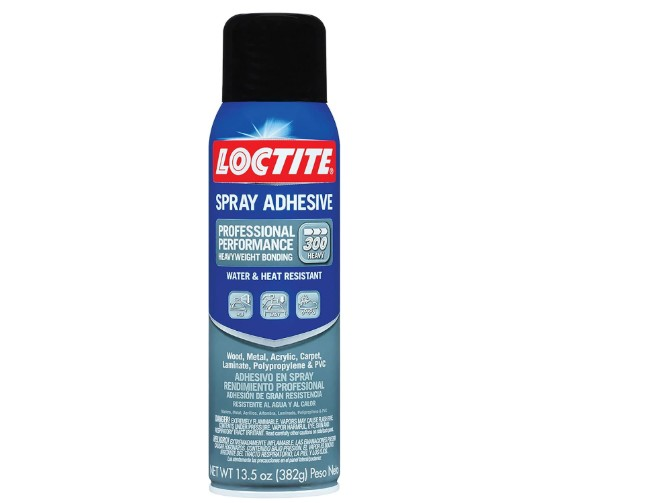
Loctite Professional Performance 300 — The Overachiever
For when your project needs to survive the apocalypse
Let me tell you about the time I used this for a marine upholstery project. I was redoing the cushions on a friend’s pontoon boat. Direct sunlight. Lake humidity. Temperature swings from freezing to surface-of-the-sun.
Three seasons later? Those cushions still look brand new.
Loctite 300 is the professional’s choice for a reason. It’s a heavyweight formula designed for situations where you can’t use mechanical fasteners (screws, staples, etc.) to support the bond. In other words, this stuff has to do ALL the work.
The good: Temperature resistant. Sets in 10 minutes (which is generous for repositioning if needed), full cure in 24 hours. Dries clear without yellowing — I’ve had this on white vinyl for two years and it still looks perfect. No bubbling, which is a godsend when you’re working with thin fabrics.
The bad: It’s pricey. Like, “do I really need the professional grade?” pricey. But honestly? For demanding applications, it’s worth every penny. Also, the 10-minute set time means you can’t rush — plan your workflow accordingly.
Best use case: Marine applications, van conversions, RV upholstery, outdoor signage, decorative laminate, and any project that will face extreme temperatures or moisture.
Pro tip from someone who learned the hard way: Multiple coats increase bond strength. For porous fabrics, do a light first coat, let it dry, then do a second coat before bonding. The difference is noticeable.
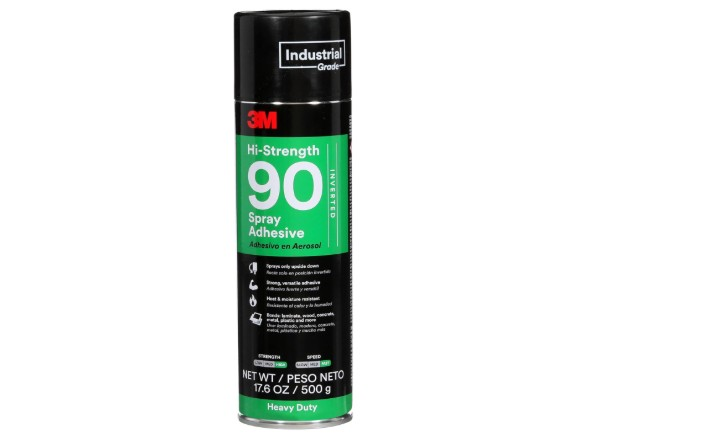
3M Hi-Strength 90 — The Industrial Beast
When you’re done playing games
This one’s for the big projects. I’m talking large surface bonding. Laminate to MDF. Insulation to metal. Concrete applications. Stuff that makes your average DIYer break out in a cold sweat.
3M 90 has a higher solids content than most spray adhesives, which means you get more coverage per square foot. That matters when you’re spraying 50 square feet of laminate sheeting.
The good: Maximum strength bond. High initial grab. Will spray upside down (game changer for overhead applications). Low VOC formula that’s CARB compliant. Works on paper, cardboard, fabric, insulation, plastic, metal, wood — basically if it exists, this stuff will bond it.
The bad: This is NOT for delicate crafts. It’s too strong. You’ll tear your fabric if you try to reposition. Also, the fast dry time means you need to work quickly and confidently.
Best use case: Large surface bonding (think conference tables, countertops), interior construction (HVAC, office partitions), tilt-up construction, and any industrial application where failure means big money lost.
Pro tip from someone who learned the hard way: Because it sprays upside down, keep a rag handy for the nozzle. The upside-down spray feature is amazing, but it can get messy if you’re not careful.
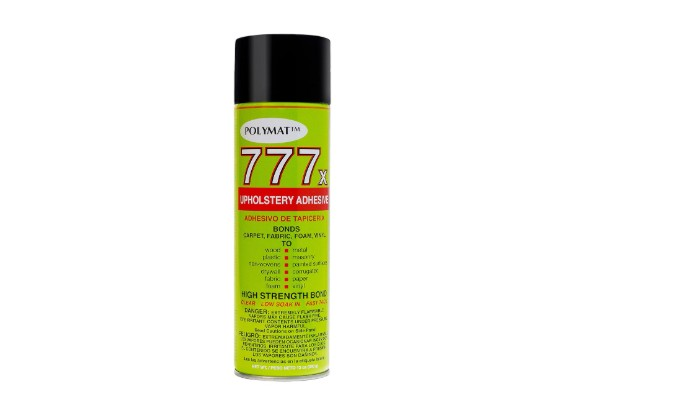
Polymat 777 — The Upholstery Specialist
The one your upholsterer friend uses
Remember that ottoman disaster I mentioned at the beginning? I eventually fixed it. Want to know how? Polymat 777.
This is a professional-grade upholstery adhesive that doesn’t get enough love in the DIY community. It’s designed specifically for fabric and foam applications, and it shows.
The good: Fast tack with foam-tearing strength (meaning the foam will rip before the bond fails). Soft, non-dimpling glue lines — this is HUGE for upholstery because nobody wants lumps under their fabric. Contains no CFCs or chlorinated solvents. Good temperature resistance up to 120°F.
The bad: The lace spray pattern takes some getting used to. It’s not a solid mist like the 3M products. But that’s actually a feature — it prevents oversaturation and soak-in on delicate fabrics. Also, 12 oz net weight means you get less product than some competitors.
Best use case: Upholstery repair, bonding felt carpet, flexible urethane or latex foams to wood, carpeting speaker boxes (which is a whole niche community, but they LOVE this stuff).
Pro tip from someone who learned the hard way: The low soak-in property is your friend. Most beginners overspray fabric adhesive, which leads to bleed-through and ruined fabric. Polymat 777 helps prevent that. Use light coats!
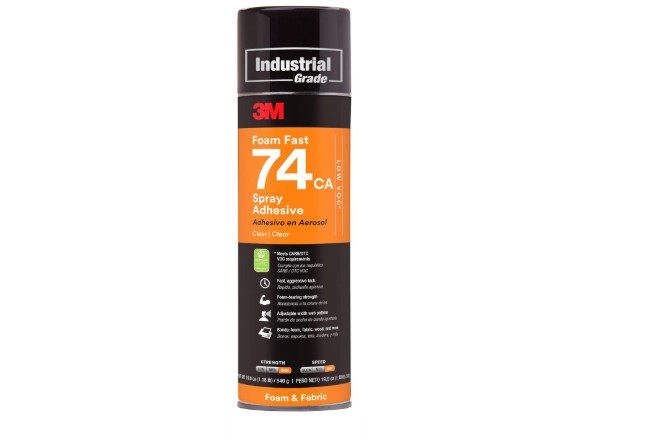
3M Foam Fast 74 — The Foam Whisperer
For when foam and fabric need to become one
This is 3M’s specialized foam adhesive, and it’s brilliant at exactly one thing: bonding foam and fabric to pretty much anything else.
I used this to attach acoustic foam panels to fabric-wrapped wooden frames for a home recording studio. The result? Professional-looking panels that didn’t cost $200 each.
The good: Aggressive tack with foam-tearing strength (again, the foam fails before the bond). High-solids content gives you higher coverage and lower soak-in. Creates soft, non-dimpling glue lines. The lace spray pattern is perfect for foam — it doesn’t saturate and collapse the foam cells.
The bad: It’s specialized. If you’re not working with foam, you don’t need this. The low VOC formula (<25%) is great for indoor use, but some people find it doesn’t feel as “strong” as the higher-VOC alternatives (spoiler: it’s still plenty strong).
Best use case: Upholstery, foam lamination, attaching foam and fabric to wood, crafts and hobbies, acoustic panels, and anything involving flexible foam.
Pro tip from someone who learned the hard way: The open time is generous enough to reposition, but don’t take too long. I got distracted by my phone once (okay, twice) and had to re-spray because the tack had dried too much.
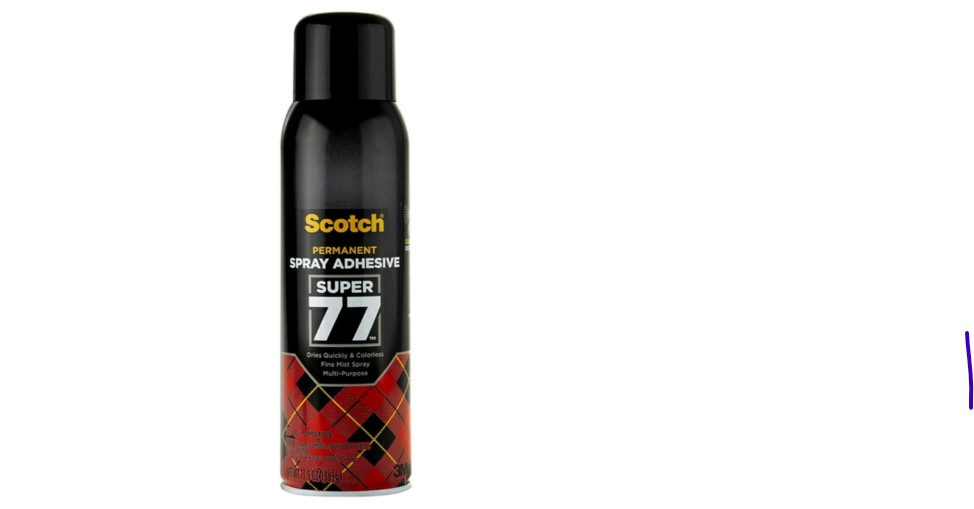
3M Super 77 Multipurpose (13.5 oz Low VOC) — The Indoor Safe Option
Same Super 77, less brain damage from fumes
This is the eco-friendly sibling of the classic Super 77. Same great performance, lower volatile organic compounds, less “I think I just lost some brain cells” feeling after using it indoors.
I keep this one in my craft room for smaller projects where I don’t want to gas out my family. (My husband thanks me.)
The good: Lower VOC means safer indoor use. Fast-tacking formula with high coverage. Dries clear with moisture resistance. Uniform spray pattern with minimal overspray. Still bonds paper, cardboard, fabric, plastic, metal, wood — just like the big brother.
The bad: It’s only 13.5 oz, so you get less product than the 24 oz classic. The bond strength is slightly less aggressive (by design — it’s meant for lighter materials). Not ideal for heavy-duty applications.
Best use case: Crafts, school projects, home repairs, smaller upholstery jobs, and anything you’re doing in a poorly ventilated space.
Pro tip from someone who learned the hard way: Just because it’s lower VOC doesn’t mean “no ventilation.” Still open a window. Still take breaks. Your brain cells are precious.
The Problem-Solving Section: Why Your Last Project Failed (And How to Fix It)
Okay, let’s get real for a minute. You’ve probably tried spray adhesive before and ended up with:
- Fabric that peeled up at the edges after three days
- Glue bleed-through ruining your beautiful fabric
- A lumpy, bumpy mess that looks nothing like the smooth finish you wanted
- Overspray on EVERYTHING within a 5-foot radius
- The dreaded “I pressed too soon and now the fabric is sliding everywhere” disaster
I’ve done all of these. Multiple times. Here’s how to fix each one.
Fabric peeling at the edges
What went wrong: You didn’t get enough adhesive on the edges, OR you used the wrong adhesive for the material weight, OR you didn’t apply enough pressure during bonding.
The solution: For edges, do a second light coat focused just on the perimeter after your main application. Also, use a roller or a block of wood to apply firm, even pressure — especially on edges. Fingers don’t cut it for edge bonding.
Best adhesive for this: 3M Hi-Strength 90 or Gorilla Contact Adhesive. Both have the aggressive tack needed to keep edges down permanently.
Glue bleed-through on fabric
What went wrong: You oversprayed. Plain and simple. Heavy coats on thin fabric will always bleed through.
The solution: Multiple light coats instead of one heavy coat. Spray from 8-10 inches away (not closer). And consider using a lace spray pattern adhesive like Polymat 777 or 3M Foam Fast 74, which are designed to prevent oversaturation.
Best adhesive for this: Polymat 777 or 3M Foam Fast 74. Both have low soak-in properties specifically to prevent this nightmare.
Lumpy, uneven finish
What went wrong: You pressed the fabric down before the adhesive was properly tacky, OR you didn’t smooth from the center outward.
The solution: Wait for the recommended tack time (varies by product — check the can!). Then start from the center of your piece and smooth outward. Use a laminate roller or a clean, dry block of wood. Don’t use your hands — they create uneven pressure.
Best adhesive for this: 3M Super 77 (either size). It has a repositionable window that lets you smooth out wrinkles before the bond sets permanently.
Overspray on everything
What went wrong: You sprayed in an unprotected area, OR you didn’t mask off your work surface, OR you sprayed from too far away.
The solution: Work in a spray booth (a cardboard box works great for small projects). Mask off everything you don’t want glued. Spray from 6-8 inches — too far = more overspray. Use low-VOC formulas which tend to have heavier particles that don’t float as much.
Best adhesive for this: The 3M Super 77 Low VOC version sprays a tighter pattern with less airborne adhesive.
Fabric sliding everywhere
What went wrong: You didn’t wait for the adhesive to become tacky before pressing. Freshly sprayed adhesive acts as a lubricant, not a glue.
The solution: Wait. I know you’re excited. I know you want to see it finished. But WAIT. Most spray adhesives need 30-60 seconds to flash off solvents and become tacky. Touch the sprayed surface lightly with a scrap piece of paper — it should feel sticky but not wet.
Best adhesive for this: Any of them, honestly. This is a technique problem, not a product problem.
The bond failed after a few months
What went wrong: You either used the wrong adhesive for the application (indoor adhesive outdoors, lightweight adhesive for heavy fabric, etc.) OR you didn’t prepare your surfaces properly.
The solution: Clean your surfaces! Wood needs to be dust-free. Fabric needs to be lint-free. Both need to be dry. Also, make sure you’re using an adhesive rated for your specific conditions (heat, moisture, UV exposure, etc.).
Best adhesive for this: For outdoor or high-moisture applications, Gorilla Contact Adhesive or Loctite Professional 300. For high-heat, Loctite 300. For general long-term indoor, 3M Super 77 or Hi-Strength 90.
How to Pick the Right Spray Adhesive for YOUR Project
Stop guessing. Here’s the simple decision tree.
Step 1: What are you bonding?
Fabric to wood (lightweight fabric like cotton, linen, polyester): 3M Super 77 (either size) or Polymat 777
Fabric to wood (heavy fabric like denim, canvas, upholstery weight): 3M Hi-Strength 90 or Gorilla Contact Adhesive
Foam to wood: 3M Foam Fast 74 — seriously, don’t use anything else
Vinyl or leather to wood: Gorilla Contact Adhesive or Loctite Professional 300
Delicate or thin fabric to wood: Polymat 777 (the low soak-in prevents bleed-through)
Step 2: Where will the finished project live?
Indoors, normal conditions: Any of these will work, but 3M Super 77 is the best value
Indoors, high humidity (bathroom, kitchen, boat): Gorilla Contact Adhesive or Loctite 300
Outdoors, direct sunlight: Loctite 300 (best temperature resistance)
Outdoors, covered but exposed to elements: Gorilla Contact Adhesive
In a car (headliner, door panels): Gorilla Contact Adhesive — this is the industry standard for auto upholstery
Step 3: How big is your project?
Small crafts (< 2 sq ft): 3M Super 77 Low VOC 13.5 oz — perfect size, less fumes
Medium projects (2-10 sq ft): 3M Super 77 Classic 24 oz or Polymat 777
Large projects (10-50 sq ft): 3M Hi-Strength 90 (better coverage per square foot)
Industrial scale: 3M Hi-Strength 90 or Loctite 300, and buy multiple cans
Step 4: How much does “repositionability” matter?
I need to be able to move things around: 3M Super 77 (either size) — has a repositionable window
I need it perfect on the first try (no adjustments): Gorilla Contact Adhesive, Loctite 300, or 3M Hi-Strength 90
Step 5: Do you have good ventilation?
Yes, I’m working in a garage or outdoors: Any product works
No, I’m in a spare bedroom or craft room: Get a low-VOC option: 3M Super 77 Low VOC or 3M Foam Fast 74 Low VOC
The “I Wish Someone Had Told Me This” FAQ Section
Q: Can I use regular spray adhesive on foam, or do I need special foam adhesive?
A: You NEED foam-specific adhesive (3M Foam Fast 74 or Polymat 777) if you’re bonding foam to anything. Regular adhesives contain solvents that can dissolve foam. I learned this when I literally melted a $40 piece of upholstery foam. It looked like a sad, deflated marshmallow.
Q: How long do I really need to wait before using the bonded item?
A: Most adhesives reach handling strength immediately after pressing, but full cure takes 24 hours. Don’t stress the bond for a full day. No heavy use, no aggressive pulling, no putting weight on it. I know you’re excited. Just wait.
Q: Can I wash fabric that’s been bonded to wood with spray adhesive?
A: Absolutely not. Spray adhesive is not designed for washing. If you need removable/washable fabric, use staples or a different attachment method. Spray adhesive is for permanent bonds that won’t see water or laundry cycles.
Q: Which spray adhesive is best for car headliners?
A: Gorilla Contact Adhesive, full stop. Ask any auto upholstery shop. The heat resistance and aggressive tack are perfect for headliners. 3M Hi-Strength 90 is a distant second. Don’t use Super 77 — it will fail in summer heat.
Q: How do I remove overspray from my work surface?
A: For fresh overspray (still tacky), mineral spirits or Goo Gone work great. For dried overspray, you’ll need to scrape it (on hard surfaces) or use acetone (test first — it can damage finishes). Best solution? Prevent it in the first place with masking and a spray booth.
Q: Why do some adhesives say “low VOC” and does it matter?
A: VOCs are volatile organic compounds — the stuff that makes your eyes water and your brain feel fuzzy. Low VOC formulas are better for indoor use and for the environment. The trade-off is that some people feel low VOC adhesives are slightly less aggressive. For most DIY projects, the difference is negligible. For industrial applications, you want the full-strength stuff.
Q: Can I use fabric spray adhesive on outdoor cushions?
A: Yes, but ONLY use adhesives rated for outdoor use: Gorilla Contact Adhesive or Loctite Professional 300. Standard indoor adhesives will break down in UV light and moisture. I have a chair cushion outside that’s held up for two years with Gorilla — still perfect.
Q: Help! I sprayed too much and now my fabric is soaking wet. What do I do?
A: Don’t press it! Let it dry completely (like, an hour), then spray a very light tack coat and bond. Trying to bond wet adhesive is a disaster — it will soak through and/or create a gummy mess. Ask me how I know.
Conclusion (Now You’re Ready to Fix Your Project the Right Way)
Look, I get it. You came here because you’re tired of failed projects. Tired of fabric peeling up at the corners. Tired of glue bleed-through ruining your hard work. Tired of standing in the adhesive aisle at the hardware store, staring at 47 different cans, feeling completely lost.
Here’s the simple truth:
If you’re doing general fabric-to-wood bonding for indoor projects, buy 3M Super 77 (the 24 oz can if you do a lot of projects, the 13.5 oz Low VOC if you’re working inside). It’s the Goldilocks adhesive — not too weak, not too aggressive, just right for 90% of what DIYers actually need.
If you’re doing something specific:
- Car headliner or outdoor furniture? Gorilla Contact Adhesive.
- Marine or extreme temperature? Loctite Professional 300.
- Large surfaces or industrial strength? 3M Hi-Strength 90.
- Upholstery or delicate fabric? Polymat 777.
- Foam of any kind? 3M Foam Fast 74.
Stop overthinking it. Stop buying the cheapest option and hoping for the best. Stop using the “all-purpose” glue from 2017 that’s been sitting in your garage.
Here’s what I want you to do right now:
- Look at your project.
- Ask yourself the five questions in the buying guide above.
- Pick ONE adhesive from this list.
- Go buy it (or click the link if you’re shopping online).
- Use the technique tips I shared (light coats, proper tack time, roll don’t pat).
- Finally finish that project that’s been mocking you from the corner of your workshop.
That ottoman I ruined? I fixed it with Polymat 777. It’s been two years. My dog has jumped on it approximately 4,000 times. My kids have eaten snacks on it (don’t tell my husband). It hasn’t budged. Not a single loose corner.
That could be you. Except with less crying on the living room floor at 11 PM.
You’ve got this. Pick your adhesive. Fix your project. And for the love of all that is holy, open a window when you spray.
P.S. — Still not sure which one to buy? Drop your specific project details in the comments. I read every single one and I’ll tell you exactly what I’d use. No judgment. I’ve made every mistake possible so you don’t have to.