Picture this. It’s a Tuesday night. You’ve just knocked over your kid’s 3D-printed dinosaur. Or worse—you go to sit down, and the left arm of your favorite gaming chair snaps off like a dry twig. You look at the two pieces of black plastic in your hand. You grab the dusty tube of Super Glue from the junk drawer. You squeeze. You hold. You count to sixty.
You let go.
The piece falls right back onto the floor.
You curse. Your finger is now glued to your thumb. The chair is still broken. And you whisper to the void: “Why doesn’t anything stick to plastic?”
My friend, I have been there. I have a graveyard of failed projects in my garage that looks like a modern art installation called “The Tragedy of Bad Adhesion.” I’ve glued my coffee mug to the table, my hand to a model car, and once, I accidentally glued a spatula to the counter for a week.
But today? Today we fix your life.
We are going to hunt down the best glue for plastic based on actual science, not marketing lies. We will figure out why your last fix failed (spoiler: it’s not your fault, it’s the plastic’s personality disorder). By the time you finish reading this, you will be the neighborhood Plastic Whisperer. Let’s do this.
Why Most Glue Fails (And Why You’re Not Stupid)
Let’s get one thing straight. Plastic is a liar. It looks solid. It feels sturdy. But on a chemical level, most plastics are basically Teflon-coated snakes. They are low energy. I don’t mean they need a nap; I mean the surface doesn’t want to bond with anything.
Here is the dirty secret: Most plastic adhesive glue you buy at the dollar store is just thick water. It sits on top of the plastic, dries hard, and then snaps off like a cheap suit because it never actually melted into the surface.
Glue fails for three hilarious reasons:
- The Invisible Grease: Plastic manufacturing uses mold release agents. It’s like non-stick spray for machines. If you don’t wash that off, the glue is sticking to grease, not the plastic.
- The Flex Factor: Rigid glue on a flexible plastic part (like a bumper) is a disaster. The part bends, the glue doesn’t, CRACK.
- The Polyethylene Problem: Some plastics (like milk jugs) are chemically designed to repel everything. Using normal glue on them is like trying to hug a ghost.
To find the strong glue for adhesives that actually works, you have to stop guessing and start identifying. You have to become a plastic detective.
The Plastic Lineup: Know Your Frenemy
Before we slap any best adhesives for plastics on the problem, we need to know which family the broken piece belongs to. Most things have a recycling symbol or a stamp (ABS, PP, etc.). Look for the little triangle.
Here is the blunt, honest, friend-to-friend breakdown of the plastics you meet every day.
The Hard/Rigid Plastics (The Easy Friends)
These plastics want to be glued. They are needy, but cooperative.
- ABS (Black Lego plastic, electronics cases): Loves you. Easy to bond. Cyanoacrylate (Super Glue) or solvent cement works like magic.
- PVC (Pipes, conduit): Needs specific plumbing cement. Don’t use school glue. Use the purple primer stuff that smells like a rock concert.
- POLYCARBONATE (Shatterproof windows, phone cases): Super strong, but picky. Epoxy works great. Warning: Super Glue can sometimes stress crack this stuff and make it look like a shattered windshield.
- POLYSTYRENE (Model car bodies, disposable cups): Dissolves beautifully with model cement. Do not use strong acetone unless you want a melted blob.
- PHENOLIC (Circuit boards, pot handles): Tough old bird. Needs a gritty epoxy.
The “Hard-to-Bond” Plastics (The Toxic Exes)
These are the jerks of the plastic world. You cannot use normal glue here.
- POLYPROPYLENE (PP) & POLYETHYLENE (PE) & HDPE & LDPE (Shampoo bottles, Tupperware, milk jugs, ziploc bags): Welcome to glue hell. Nothing sticks. I mean it. Nothing sticks unless you use a special primer like Loctite Polyolefin or flame treatment. You need a plastic adhesive glue specifically marked “for polypropylene.”
- NYLON (Gears, hammer heads, zip ties): Oily by nature. It sweats lubricant. You need a two-part epoxy and you must rough it up with sandpaper until it looks like a cat scratched it.
- PET (Soda bottles, food trays): Stubborn. Requires special cyanoacrylate or a urethane glue.
The Comparison Table (Save This, Print It, Frame It)
Here is your cheat sheet. Tape this inside your junk drawer. This table tells you exactly what to buy for every scenario.
| Type of Plastic | Bondability | The Best Glue for Plastic Here | Pro Tip (Don’t Ignore This) |
|---|---|---|---|
| ABS | Excellent | Solvent Cement / Cyanoacrylate (Super Glue) | It melts the surface slightly for a chemical weld. |
| PVC | Very Good | PVC Primer & Cement (the orange can) | Must use primer first. No shortcuts. |
| POLYCARBONATE | Good | Two-Part Epoxy (30-min cure) | NEVER use cheap super glue; it causes “crazing” (cracks). |
| POLYSTYRENE | Good | Plastic Model Cement (Testors) | It’s a gooey liquid. Apply thinly. |
| NYLON | Difficult | Two-Part Epoxy + Sanding | Rough it up, then wipe with alcohol. |
| PP / PE / HDPE | Extremely Difficult | Loctite Plastics Bonding System (with activator pen) | You NEED the primer pen. Full stop. |
| PET | Difficult | Specialized Cyanoacrylate (Gorilla Glue micro precise) | Flexible is better. |
| PHENOLIC | Moderate | High-Viscosity Epoxy | Clean the dust off before gluing. |
The “Quick Fixes & Small Gaps” Life Hacks
Sometimes you don’t have a structural break. Sometimes you just have a hairline crack in your car’s dashboard, a split in a sunglasses arm, or a hole in a garden hose nozzle. You don’t want to mix epoxy for that. You want a quick fix.
For small gaps (under 0.5mm):
- Super Glue (Thin): Use capillary action. Hold the crack, touch the glue to the edge, and let physics suck it in. It turns a crack into a solid line.
- Baking Soda + Super Glue Trick: This is old-school mechanic magic. Fill the gap with baking soda, drip thin super glue on it. It turns into instant, rock-hard white plastic. You can sand it and drill it. I fixed a shattered taillight cover with this and it lasted 4 years.
For gaps that need flexibility (like a vacuum cleaner hose):
- Shoe Goo or Plasti-Dip: This is rubber in a tube. It isn’t “pretty,” but you can slather it on a split hose, let it dry, and it bends with the plastic. It’s ugly, but it works.
In-Depth Reviews: The Best Adhesives for Each Plastic Type
Let’s get granular. You have the table. Now you need the psychology of the glue.
1. The King of Everything: Epoxy (J-B Weld PlasticWeld)
If you have Hard/Rigid Plastics like ABS, PVC, or Polycarbonate, just buy Epoxy. Epoxy is the bodybuilder of the best adhesives for plastics. It comes in two tubes (resin + hardener). You mix it. It smells like death. It takes 15 minutes to set.
- Why it wins: It fills gaps. If your break is jagged or missing a chunk, epoxy fills the hole. Super Glue cannot fill gaps; it only works if the parts touch perfectly.
- Humor break: I once used epoxy to fix a broken toilet handle. I didn’t wear gloves. I had “hardened plastic fingerprints” for a weekend. Soooo…. Wear gloves.
2. The Speed Demon: Cyanoacrylate (Gorilla Super Glue Gel)
For clean breaks on Rigid Plastics, this is the best glue for plastic if you are impatient. The “Gel” version is better than liquid because it doesn’t run.
- The Catch: It is brittle. If you glue a plastic clip that has to flex to snap into place, the glue will shatter.
- The Solution: Use a tiny amount. Less is more. If you use too much, it takes forever to dry and turns white (blooming), ruining the look.
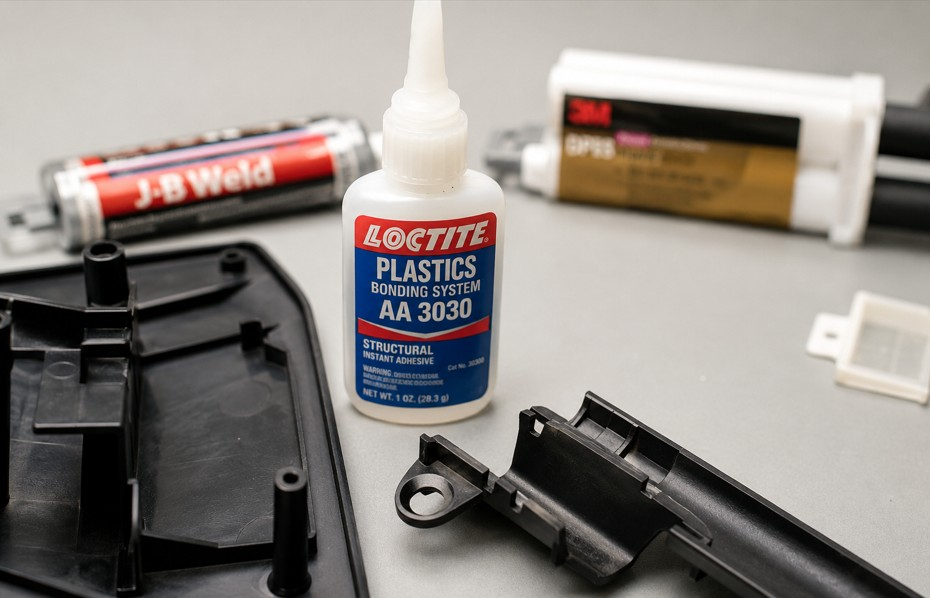
3. The Polypropylene Savior: Loctite Plastics Bonding System
Okay, listen carefully. You have a HDPE or Polypropylene broken part (like a kayak fitting or a Tupperware lid). You have tried everything. It never sticks.
Buy Loctite Super Glue Plastics Bonding System. It comes with a little “activator” pen. You draw on one side with the pen, put glue on the other, and clamp.
- Why it works: The pen changes the surface energy of the “un-glueable” plastic. It is actual sorcery. Without that pen, you are wasting your money.
4. The Flexible Friend: 3M Scotch-Weld DP8005
This is for pros, but you can buy it online. It is an “acrylic adhesive.” It is expensive ($30 a tube).
- Why care? It bonds Nylon, Polyethylene, and even oily metals. It doesn’t shatter when you drop it.
- Verdict: Overkill for a toy. Mandatory for a car bumper.
The Step-by-Step Ritual (How to Prep the Surface)
You can buy the strong glue for adhesives money can buy, but if you skip prep, you are gluing dust together. You wouldn’t paint a dirty wall. Don’t glue dirty plastic.
Here is the 4-step prayer to the Adhesion Gods.
Step 1: The Wash (Degrease)
Do not just blow on it.
- Wash the parts in warm, soapy water (Dawn dish soap is king).
- Rinse them.
- Crucial: Dry them. Do not touch the bonding edges with your fingers. Your fingers have oils. Skin oil is glue kryptonite.
Step 2: The Rough-Up (Abrasion)
Glue needs texture to grab. Smooth plastic is a slide for glue.
- Sandpaper: Use 80-grit or 120-grit. Go to town on the surface. You want it to look frosty and scratched. “If it doesn’t look ugly, it won’t stick,” is my motto.
- For small gaps: You can use a razor blade to score a cross-hatch pattern (like tiny waffles) on the surface.
Step 3: The Final Wipe (Activation)
After sanding, you have dust.
- DO NOT USE: Rubbing alcohol (70%). It leaves residue.
- DO USE: Isopropyl alcohol 91% or higher, or Acetone (nail polish remover – but test on a hidden spot first because acetone melts some plastics).
- Action: Wipe the surface with a lint-free cloth (coffee filter works great). Let it evaporate for 60 seconds.
Step 4: The Surgery (Application Procedure)
This is where we separate the pros from the “my fingers are glued together” crowd.
For Super Glue (Cyanoacrylate):
- Apply one tiny drop per square inch. Seriously. Tiny.
- Press parts together hard for 30 seconds.
- Do not blow on it. Your breath has moisture, which makes CA glue dry cloudy.
- Walk away for 2 hours. Do not check on it. “Letting it breathe” is a myth; you are just wiggling it.
For Two-Part Epoxy:
- Mix on a disposable surface (cardboard, popsicle stick). Mix for 60 seconds until it is one uniform color. No streaks.
- Apply to both surfaces (like peanut butter on two slices of bread).
- Clamp it. Use masking tape, rubber bands, or clamps. Epoxy tries to expand as it cures. If you don’t clamp it, it will push the joint apart.
- Wait 24 hours. Yes, a whole day. If you touch it in 4 hours, it will be sticky. Patience is free.
For the “Impossible” Plastics (PP/PE):
- Flame treatment (hold a lighter flame 2 inches from the surface for 1 second – do not melt, just wave it) OR use the chemical primer pen.
- Follow the epoxy steps above. Do not use super glue here.
Why We Need to Talk About “Nylone” (And the Polyester Cousins)
A quick sidebar on NYLONE (often misspelled as Nylon). I see people trying to glue nylon gears with hot glue. Please stop.
Nylon is self-lubricating. That means it sweats silicone. You must, and I mean must, use sandpaper first. Then use a specialized plastic adhesive glue like “3M Scotch-Weld” or “Permabond TA4610.”
If you use regular hardware store epoxy, it will stick for a day, then peel off like a sunburn. It’s not the glue’s fault. It’s the nylon’s oily personality.
FAQS (Frequently Asked, Stupidly Argued)
Q: Is Gorilla Glue the best glue for plastic?
A: The original brown Gorilla Glue? No. That stuff is for wood and foam. It expands like a monster. It will push your plastic parts apart. Gorilla Super Glue Gel (the blue bottle) is good for hard plastics. Gorilla Epoxy (the syringe) is excellent for rigid plastics. But the brown stuff? Keep it away from your toys.
Q: Can I use super glue on Polycarbonate (like a fish tank)?
A: No! Please, for the love of your fish, do not. Super glue (cyanoacrylate) releases heat as it cures and causes “crazing”—tiny stress fractures that look like ice. The joint will look bad, and then a week later, it will snap. Use Aquarium Silicone (for glass) or Weld-On #4 (for plastic to plastic). If you use super glue on a polycarbonate visor, it will shatter when you look at it funny.
Q: I glued my fingers together. Help.
A: Classic. Do not yank. Acetone (nail polish remover) works, but it burns and dries out your skin. The real trick? Soak your fingers in warm, soapy water and use a pumice stone or a fingernail file to gently grind the glue off over an hour. Or just peel it off tomorrow. It will flake off naturally. Welcome to the club.
Q: What is the cheapest way to glue HDPE?
A: A soldering iron. Seriously. For HDPE and Polypropylene (milk jugs), a chemical bond is hard, but a thermal weld is easy. Melt the edges with a soldering iron and push them together. Use zip ties as “filler rods” (zip ties are usually nylon or polypropylene). It smells terrible. Do it in the garage. But it costs zero dollars.
Q: Why does my plastic feel oily even after washing?
A: That is “plasticizer migration.” Old vinyls (PVC) and rubbers leech out oil as they age. You can’t glue old, crumbling plastic. If the plastic is sticky or powdery ( hydrolysis), throw it away. No glue saves rotten plastic.
Q: What is the “strongest” adhesive technically?
A: For shear strength (sliding force), Epoxy. For tensile strength (pulling apart), Acrylic adhesives (like 3M VHB tape or DP8005). For a consumer fix, J-B Weld PlasticWeld is the King Kong of the hardware store.
Real-World Scenarios (What to buy right now)
Let’s play a game of “What do I buy?”
Scenario A: My kid’s ABS plastic Stormtrooper action figure snapped at the knee.
- Buy: Tamiya Extra Thin Cement (solvent).
- Why: It seeps into the crack and melts the plastic back together. It will be stronger than the original.
Scenario B: My Polypropylene car trim clip snapped.
- Buy: Loctite Plastics Bonding System (the one with the activator pen).
- Why: Nothing else touches polypropylene. Nothing.
Scenario C: I dropped my Polycarbonate drone arm. It’s cracked, but not in half.
- Buy: Bob Smith Industries BSI 30-min Epoxy.
- Why: It’s flexible enough to handle vibration. Do not use 5-minute epoxy; it’s too brittle for drones.
Scenario D: My PVC pipe garden fountain cracked.
- Buy: Oatey All-Purpose Cement (the green can).
- Why: It chemically dissolves PVC. It will last until the heat death of the sun.
Scenario E: I have a random white plastic (Polystyrene) model kit.
- Buy: Testors Liquid Cement.
- Why: It brushes on like nail polish. Use it sparingly.
Conclusion (Do this, not that)
Listen to me. You are about to walk out to your car or your garage. You are holding a broken piece of plastic. You are tempted to grab that $1.99 tube of “Universal Super Glue” from the checkout lane.
Stop. Put it down. Back away slowly.
That 1.99isgoingtofail.Thenyouaregoingtothrowthebrokeniteminthetrash.Thenyouaregoingtobuya30 replacement. You are literally burning money because you didn’t want to spend $8 on the right plastic adhesive glue.
Here is your action plan:
- Identify the plastic. Look for the chasing arrows or the stamp. If you see a “2” (HDPE) or “5” (PP), you buy the special activator glue. If you see “7” (Other/Polycarbonate), you buy Epoxy.
- Clean it like a surgeon. Soap, water, alcohol, sandpaper. Do this while watching Netflix. It takes 5 minutes.
- Choose your weapon.
- Fast & Hard (Rigid plastics): Super Glue (Gel)
- Strong & Gap-filling (Most repairs): Two-part Epoxy
- Impossible plastics (Tupperware, bumpers): Loctite Activator Pen system
- Clamp it and leave it. Put it in a closet. Do not look at it for 24 hours. I know you want to poke it. Don’t.
You now know more about gluing plastic than 99% of the human race. You are the chosen one.
Go forth, fix that chair, save that model, and for the love of all that is holy, do not glue your mug to the table again.
Got a horror story? Reply in the comments. I want to hear about the time you glued your shoe to the floor. We all have one.